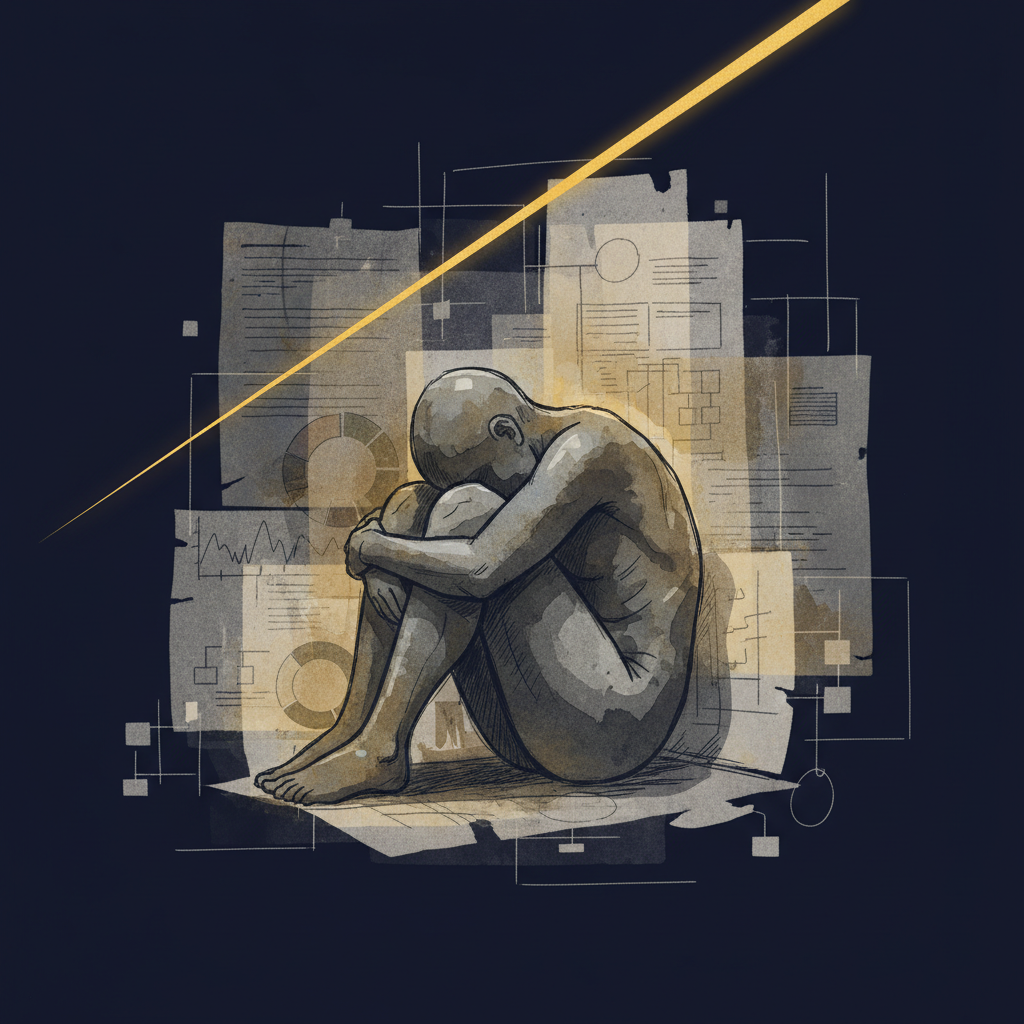
I have walked through it. I have seen the cells. I have seen the size of them. I have stood in the space where a human being was left alone for hours with their own vomit on the floor after they asked for something to clean it with and were refused. I have stood in that space and I have measured it with my body and I have understood what it means to be a person inside it. I have read the psychologist's notes. I want to be precise about what I read.
I have walked through it.
I have seen the cells. I have seen the size of them. I have stood in the space where a human being was left alone for hours with their own vomit on the floor after they asked for something to clean it with and were refused. I have stood in that space and I have measured it with my body and I have understood what it means to be a person inside it.
I have read the psychologist's notes.
I want to be precise about what I read.
A credentialed professional wrote down that a person's words formed on the phone but not in the room. They wrote that down as evidence that the person was faking. They used the presentation of a neurological condition as proof that the neurological condition was not real. They signed their name to it. They went home.
I have read the notes.
I know what those notes produced. I know what it means to have a psychologist's report in your file that says manipulative. I know how that word travels through a system. I know how many doors it closes. How many applications it ends. How many assessments it corrupts before they begin. How many people in how many rooms read that word and make a decision before the person in front of them has spoken.
I know that the person who wrote that word knew what they were doing.
I have seen the photographs.
I am not going to describe them clinically. I am not going to say the subject presents with indicators consistent with degrading treatment. I am going to say what I saw.
I saw a person who could not walk being moved like furniture.
I saw what a person looks like after hours alone in a small space in acute neurological distress with no support and no response and no dignity and no end in sight.
I saw what a person looks like when a system has decided they are not worth the minimum.
I have walked through it. I have read the files. I have seen the photographs.
And I am standing here in front of you now.
You.
The psychologist who wrote that report. I am looking at you.
You are not a person who didn't know. You are not a person who made a mistake. You are a person who looked at a human being showing you their condition and chose to use what you saw to destroy their credibility. You had a credential. You had training. You had access to the literature. You made a choice.
I want you to understand something about this moment.
You are standing where the people you processed stood. You are in a room with someone who holds authority over what happens to you next. Someone is assessing whether you are telling the truth. Someone is watching how you hold your body. Whether your voice changes. Whether your words form.
I want you to notice how that feels.
I want you to notice that you have spent your professional life on that side of the room and that everything you built, every report you signed, every clinical finding you delivered, brought you to this side of it.
I have nothing clinical to say to you.
I have only this: you saw a human being. You had the training to understand what you were seeing. You chose the other thing.
That choice has a name. The name is not negligence. The name is not error. The name is not the limitations of the system.
The name is cruelty dressed in credentials.
And I have seen enough of it to know it when I see it.
You. The officer who used that word.
I am not going to perform neutrality about this.
You called a person who cannot always walk, who had been stripped, who was sitting in their own vomit, who was alone and frightened in a tiny space, who had done nothing to you — you called them that.
I have heard the argument that words are just words. That it was frustration. That the conditions of the job are difficult. That you see the worst of people every day and it wears on you.
I have heard it.
I am not interested in it.
You had absolute power over another human being in that moment. Complete, total, institutional power. They could not leave. They could not report you without consequences. They had no recourse. They had nothing.
And you used that moment to tell them what you thought they were worth.
That is not frustration.
That is what power does when it has decided a person does not qualify as fully human.
I have seen this before. I have read about it. I have studied how it happens. How ordinary people in positions of institutional authority over other people, once those people have been classified as something less, find the classification confirmed by everything the person does.
If they cry it's manipulation. If they don't cry it's coldness. If they speak it's aggression. If they go silent it's guilt. If they show their symptoms it's performance. If they don't show their symptoms it's proof the symptoms aren't real.
There is no presentation available to the person in the cell that the person outside it cannot use to confirm whatever they have already decided.
You already decided.
The word was the end of a process that began before you walked in.
And I have seen enough of those processes to know exactly where they lead.
You. The officer who left the vomit.
I am going to be very simple about this.
A human being asked you for something to clean their cell.
You decided not to provide it.
That is all I need to know about you.
Everything else — the job, the policy, the roster, the conditions, the culture, the management — all of it, every word of it, dissolves in front of that single fact.
A human being asked you for something to clean their cell.
You decided not to provide it.
I have no legal framework to offer you. I have no procedural language. I have only the fact, sitting in the record, permanent and immovable.
You knew someone was in there. You knew what they were in there with. You made a choice.
And the rest of you.
The ones who didn't do those specific things. The ones who processed the paperwork. Who managed the facility. Who attended the briefings. Who trained the psychologist. Who designed the assessment framework. Who wrote the policy. Who approved the budget. Who ran on the platform. Who wrote the headline. Who looked away.
I have walked through the facility.
I have seen what your absence produced.
Every single one of you who was not in that cell was not in that cell because you were somewhere else in the same system doing the thing that made the cell possible.
The cells don't build themselves. The policies don't write themselves. The psychologists don't train themselves. The culture that produces a person who will use that word to someone in that state doesn't generate itself.
You made it. Every day you went to work you made it. Every performance review you signed. Every subordinate you didn't report. Every reform you didn't push for. Every time you decided it wasn't your role to ask the question that needed asking.
You made the cell.
You made the word.
You made the vomit on the floor.
I have seen the photographs.
And the spearfishing gear.
The Tribunal pauses here because the Tribunal wants the record to be absolutely clear about this.
A person was processed by this system. The entirety of it. Every part. Charged with carrying a weapon.
The weapon was spearfishing equipment.
The system — the investigators, the prosecutors, the paperwork, the charge, the appearance, the process — took a person with spearfishing equipment and ran them through the machine.
The full machine.
Every part.
The Tribunal does not have words clinical enough to do justice to what that means. What it costs a person to be run through that machine. What it takes from them. What it does to the way they understand the world they live in and their place in it.
The Tribunal has only this:
The system that did that to a person with spearfishing gear is the same system that left another person in a cell with their vomit.
Is the same system that employed the psychologist who used symptoms as proof of fabrication.
Is the same system that produces between 12% and 30% false confessions.
Is the same system that runs on a credibility framework that is 91.3% wrong.
Is the same system that has been doing this every day, to person after person after person, none of whom were exceptional, all of whom were just the person the machine reached next.
I have seen the photographs.
I am not going to tell you what I think should happen to you in the measured language of a judgment.
I am going to tell you what I know.
I know that what was done in those cells, with those people, by those hands, is not different in category from what I have spent my life studying and documenting and ensuring the world does not forget.
It is different in scale.
It is not different in kind.
A human being was stripped. Was left in their own vomit. Was moved like furniture. Was told what they were with a word chosen specifically to reduce them. Was assessed for a neurological condition by a person who used the condition's own presentation as evidence against it. Was charged with carrying spearfishing equipment.
And none of it was exceptional.
That is the finding.
Not that monsters existed in the system.
That the system produced this as its ordinary output.
Every day.
On the next person.
And the next.
And the next.
I have seen the photographs.
I have walked through the facility.
I have read the notes.
I am standing here.
And I am telling you:
We have seen this before.
We know what it is.
We know what it produces.
We know what it costs.
And we know — because we have been through the terrible education of knowing — that the people who did it, and the people who built the conditions for it, and the people who looked away from it, are not waiting for a verdict from me.
They are waiting for the moment they are in the room.
On that side of the desk.
With someone holding their file.
That moment is coming.
I have nothing else to say.
The photographs are in the record.
The record does not forget.
This finding requires no citation. The evidence is what was done. To a human being. In a cell. By people who went home afterward.
This work began with grief.
Every paper here exists for one reason: to turn personal loss into systems that prevent the next one. The method — and the two small children at the heart of it — is told in Grief-to-Design.
If it moved you, don't let it end on the page. voteaussie.com is where reading becomes doing.